

About LNG
LNG Process Chain
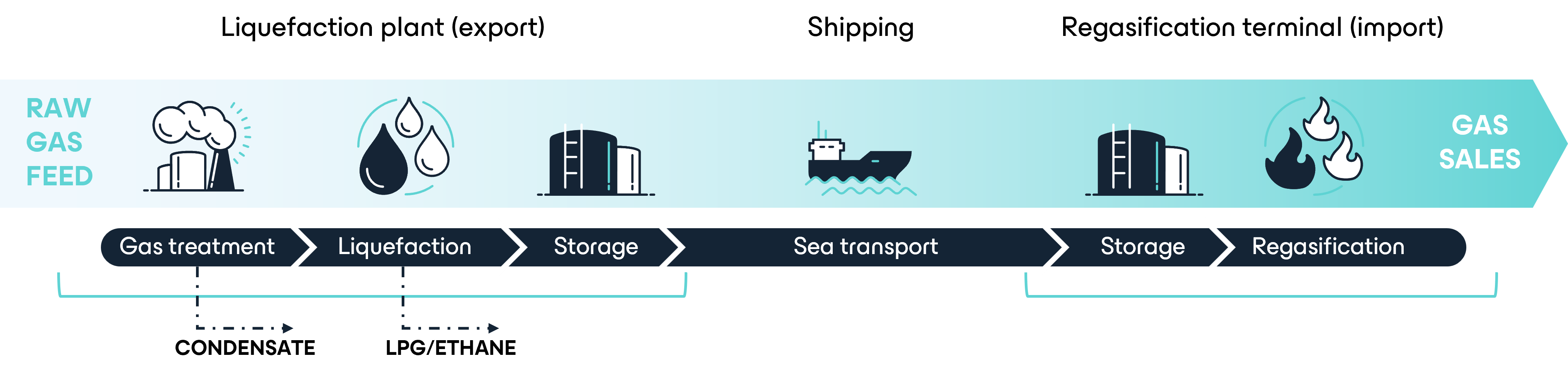
The LNG Process Chain includes the Extraction, Processing, Liquefaction, Transport, Storage, Regasification and Distribution to consumers of LNG.
Extraction: Natural gas is extracted from drilled wells, producing “feed gas.”·
Processing: The gas is cleaned by removing impurities like CO₂ and water.
Liquefaction: The gas (mainly methane) is cooled to around -162°C to become LNG.
Transport: LNG is shipped in double-hulled vessels or transported by specialized trucks.
Delivery: LNG is received at onshore terminals, floating units, or peak-shaving facilities, then stored in insulated tanks.
Unloading: Cryogenic arms or hoses transfer LNG from ships to terminals safely.
Regasification: LNG is converted back to gas using vaporizers.
Distribution: Odorants are added, gas is metered, and then delivered via pipelines to end users.
Safety systems are integrated throughout the LNG process chain. For example, during unloading, the Power Emergency Release Coupler (PERC) ensures safe disconnection in emergencies, and Emergency Shutdown Systems (ESDs) immediately terminate the loading process with no leakage.

LNG: A Reliable and Sustainable Energy Solution
Once regasified, LNG plays a key role across a wide range of applications. It provides dependable energy for cooking, and heating in homes, businesses, and public facilities. LNG is a feedstock for industries such as fertilizers, chemicals, pharmaceuticals while also serving as a cleaner-burning fuel for industrial processes. For Power Generation , LNG supports reliable electricity production with a lower carbon footprint compared to other fossil fuels. LNG is a sustainable fuel alternative for maritime shipping and heavy-duty road transport, reducing greenhouse gas emissions and air pollutants in sectors where decarbonization is challenging. Moreover, the GHG footprint of LNG can be further reduced by incorporating biogas or e-natural gas.